• Blog
  • Amazon Shop
  • Pyr Apparel & Gifts
  • Nav Social Menu

    • Email
    • Facebook
    • Instagram
    • LinkedIn
    • Pinterest

It's Dog or Nothing

All Things Great Pyrenees

  • Blogwhat’s happening
  • Aboutwho we are
  • Breed Infoall things pyrenees
  • Mediapartner with the pyrs
    • Awards & Recognition
  • Contactlet’s chat
    • Updates & Exclusive Deals
    • Disclosure
  • Skip to secondary menu
  • Skip to main content
  • Skip to primary sidebar
  • Skip to footer

giant breed

Meet the Giants: Cane Corso

November 30, 2015 5 Comments

This week on Meet the Giants, we're talking about the Cane Corso! Read more for tons of fabulous breed information!

Next up on our Meet the Giants series, the Cane Corso! I’ve only met one Cane Corso and he was such a stunning boy. Since I don’t know much (well, really anything) about the breed, Teresa Mysyk is going to help us out today!

All information and photos are credited to Teresa Mysyk.

This week on Meet the Giants, we're talking about the Cane Corso! Read more for tons of fabulous breed information!
Garth

If you currently have a Cane Corso, please list the name, age, and gender for each.
Moose, 4, male

Are there any other names/nicknames for the Cane Corso? If yes, list here.
Corso, Cane, and Italian Mastiff

What are three words you would use to describe the Cane Corso?
Powerful, sensitive, and intelligent.

What is the average size of a Cane Corso?
Around 26” inches at the shoulder and 90 to 100 pounds.

What are the acceptable colors of the Cane Corso?
Black, Black Brindle, Chestnut Brindle, Fawn, Gray, Gray Brindle, Red are the acceptable colors with or without markings of Gray Mask or Black Mask.

What is the average lifespan?
10 to 11 years

What was the Cane Corso bred to do?
This is a hunting mastiff. They are the light sporting mastiff. 🙂

This week on Meet the Giants, we're talking about the Cane Corso! Read more for tons of fabulous breed information!
Athena

How much exercise does a Cane Corso typically need?
This is an energetic mastiff. They are considered a medium energy breed but I would classify it more medium high. They love to run and play and are a far cry from the English Mastiff or even the other Italian Mastiff, the Neapolitan.

What are some common health problems?
They are a strong well-built animal but being large breed dysplasia, bloat are to be considered as well as other orthopedic issues. They are also reported to have high rates of seizure disorders and heart disorders.

How much grooming does the Cane Corso require?
They are a short coated dog. Grooming is minimal but mine love to roll in mud so there is some bathing.

What do you wish people knew about the Cane Corso before bringing one home?
This is an intelligent sensitive breed. I am a proponent of positive training and this breed demands it. This is a dog that needs to have a strong bond with its family. This large, impressive animal/ little, adorable puppy needs you for love, direction, comfort, protection as well as shelter, food, and water for the entirety of its life.

This week on Meet the Giants, we're talking about the Cane Corso! Read more for tons of fabulous breed information!
Moose

Why do you love the Cane Corso?
When Moose came into my life I swore I wouldn’t have another. I have since had three more. They are smart and eager to please. His first foster home was unable to care for him so I was asked to help out.

Moose came in with issues. He would jump on people. He would seek out eye contact with folks and growl, he meant it too. He was an 85-pound fearful ball of teeth and fur. He was especially pushy with women and kids.

I have kids. This was an issue. Operation life is awesome began. Moose loves other dogs. He is a little more excitable than I like on a leash but he gets on well with them.

He is also great with other animals, all his stuff was focused on people. So we showed him a posh life with good food. When he would act out he would be removed from the room and sent to his bed. He decided pets and cuddles are the way to go. He now sleeps with the oldest.

Moose had a high bite resistance. He would have bitten had he been pushed but he gave us loads of warning so we could diffuse and not escalate. I would not recommend this with other dogs and kids. 🙂

He is now a very much beloved member of the family. He has become invaluable with other dogs we foster. I wouldn’t dream of giving him up but when we took him it was because we didn’t want him to get in trouble somewhere else.

My other foster Corsos were less Athena, female, fawn with a gray mask. She had anxiety, likely from the many homes she had. She was here a year before moving on to her furever home.

She was so smart, she would catch onto anything we asked her to do. She loved agility, long walks, playing rope. She didn’t like carrying a backpack, though. Now, she is an only dog and I hope her life is perfect and full of snuggles.

Garth, male, black with brindle legs. He was a sweet goofy 10-month-old puppy. At 100 pounds, he was a lot to handle, though. He came in with the worst aggression story, but I never saw it. He was a 100 pound, 10-month-old puppy.

He had no size awareness, but there was no mean in that dog. He was so smart and learned so many tricks. He loved to chase his ball and play in the snow. He has a great life now in a wonderful home.

Yoda, male, gray brindle. Yoda was a talking growling monster. He had been relinquished to the humane society and was garnering the wrong kind of attention. I brought him home to foster.

Yoda is 130 pounds, he is very large for a Corso. Yoda was a fearful dog. He was short on bite resistance with people he wasn’t familiar with. He made a lot of noises constantly growling and demanding things. He stole my heart. This was one of the hardest times I have had giving up a foster. He has a wonderful home with another amazing dog.

They are smart, they need a solid relationship with their people. Love, direction and connection are the keys.

This week on Meet the Giants, we're talking about the Cane Corso! Read more for tons of fabulous breed information!
Yoda

Anything else you want to say?
This is really the best way for all breeds, but the smaller ones do less damage.

Interested in adding a Cane Corso to your family? Check out Big Dogs Huge Paws to see their available Corsos and determine if they’re the breed for you!

Pin It!

This week on Meet the Giants, we're talking about the Cane Corso! Read more for tons of fabulous breed information!

Filed Under: Meet the Giants, What's New Tagged With: breed information, giant breed, meet the giants

Meet the Giants: Great Dane

November 23, 2015 11 Comments

This week on Meet the Giants, the Great Dane! Come learn about this majestic breed with us!

Next up – the Great Dane! Mauja and Atka have a few Great Dane buddies and it’s so much fun to see them run around and play. Thinking about adding a Great Dane to your family? Here’s some information about this stunning breed.

Special thanks to Kristie Mendralla for the awesome information and photos!

This week on Meet the Giants, the Great Dane! Come learn about this majestic breed with us!

If you currently have a Great Dane, please list their name, age, and gender.

Ripley, 7, Male. (Previously had Hudson and Porter, both male Danes.) We also have a male English Mastiff named Bromley who is 6 yrs old.

Are there any other names/nicknames for Great Danes?

Great Dane is frequently shortened to Dane. They are often called Velcro Dogs because they are happiest when they are with their people.

What are three words you would use to describe the Great Dane?

Goofy, Playful, Affectionate

This week on Meet the Giants, the Great Dane! Come learn about this majestic breed with us!

What’s the average size of a Great Dane?

Males are generally 130-180 lbs, Females are generally 100-150 lbs.

What are the acceptable colors of a Great Dane?

There are six colors of Dane that are acceptable for showing: Fawn, Mantle, Harlequin, Brindle, Blue, Black. Danes can come in many other colors though, the most common are Merle and White.

What is a Great Danes average lifespan?

Generally 6-9 years, although occasionally you’ll hear of one making it to 11 or 12.

What were Great Danes originally bred to do?

Originally bred to hunt boars.

This week on Meet the Giants, the Great Dane! Come learn about this majestic breed with us!

How much exercise do Great Danes typically need?

1-2 decent walks a day are sufficient. They are generally couch potatoes and make excellent apartment dogs, which seems counterintuitive given their size. One thing to note is that Danes are not considered fully grown until they are 2 and their growth plates have closed.

Anyone looking for their Dane to be their running partner needs to be cognizant that they can’t be taken running until they are at least 2, and it should be cleared with a vet first.

What are some common health problems for Great Danes?

Great Danes are especially prone to Gastric Dilatation-Volvulus (GDV), commonly known as bloat. This is a condition in which the stomach fills up with gas, and as the pressure increases, the stomach can rotate in the abdomen, cutting off blood supply to the organs.

This condition progresses rapidly and can cause the animal’s death in a matter of hours. Sometimes, emergency surgery can save the dog, but it can cost anywhere from $3,000- $5,000.

Danes are also prone to orthopedic issues like hip dysplasia and spondylosis, as well as a neurological condition called Wobbler Syndrome. It’s caused by a narrowing in the cervical vertebrae and causes the dog to have a “wobbly” gait in the rear legs.

In the most severe of cases, the dog gradually loses control of their rear end until paralysis sets in. Surgery can be an option for some dogs, but can cost upwards of $10,000.

How much grooming do Great Danes need?

Very minimal. Great Danes have short coats and are low odor. We only bathe our Dane once a year, usually in the Spring, and use grooming wipes occasionally in between. Great Danes do shed, but their hair is very fine. We use a rubber curry brush once a day to remove excess hair, but many people don’t brush their Danes at all.

This week on Meet the Giants, the Great Dane! Come learn about this majestic breed with us!

What do you wish people knew about Great Danes before bringing one home?

Great Danes are meant to be with their people. They are nicknamed “velcro dogs” for a reason. They are not meant to be locked outside and used as guard dogs, particularly in the winter when their short coat is no barrier to the weather.

It’s also important to note that Great Danes eat a decent amount of food per day. Our Dane is 130 lbs and eats 6 cups of kibble per day. The average Labrador eats 2 cups a day, so it’s important to factor cost of kibble into your monthly budget.

Further, big dogs cost more in almost all aspects. They need bigger, more expensive dog beds that will stand up to their weight. Most medications are administered by weight, so vet care is more expensive for giants as well.

Why do you love Great Danes?

Great Danes are the clowns of the dog world. They are goofballs who adore their people and want to be with them at all times.

Anything else you want to say?

It should be noted that Danes both drool and snore, so potential adopters would want to be aware of that. 🙂

There we go friends – the Great Dane! Interested in adding a Dane to your clan? Head over to Big Dogs Huge Paws to see their available Danes! Do you have a Great Dane? Anything else we should add to this post?

Pin It!

This week on Meet the Giants, the Great Dane! Come learn about this majestic breed with us!

Filed Under: Meet the Giants, What's New Tagged With: breed information, giant breed, meet the giants

Meet the Giants: Newfoundland

November 9, 2015 17 Comments

This week on Meet the Giants - the Newfoundland! Check back weekly for information about other giant breeds!

Last week we kicked off our Meet the Giants series with the Great Pyrenees. Today, our friends over at My Brown Newfies will be talking all things Newfoundland!

Do you currently have a Newfoundland?

Sherman-9 years old. Male. Leroy-7 years old. Male

This week on Meet the Giants - the Newfoundland! Check back weekly for information about other giant breeds!

Are there any other names/nicknames for the Newfoundland?

Newf. Newfie.

What are three words you would use to describe Newfoundlands?

Gentle. Loyal. Massive.

What is the average size of a Newfoundland?

Males=130-150 lbs. Females=100-130 lbs

What are the acceptable colors of a Newfoundland?

Black, Brown, Grey and Landseer (white with black markings)

What is the average lifespan?

To age 8-10 but many Newfoundlands these days are living well past 12!

What were Newfoundlands bred to do?

Water rescue and draft work, but many Newfoundlands also can be found doing therapy work in nursing homes, hospitals and schools.

How much exercise do Newfoundlands need?

Moderate to low. Should have daily walks and belly rubs.

What are some common health problems?

Hip dysplasia, elbow dysplasia, SAS, hypothyroidism, cystinuria. allergies, bloat.

How much grooming does the breed require?

Daily

This week on Meet the Giants - the Newfoundland! Check back weekly for information about other giant breeds!

What do you wish people knew about Newfoundlands before bringing one home?

That they are a full time commitment and those cute little fluffy puppies will quickly grow to giant dogs that shed and drool all over house. They are a breed that is happiest when they are with their family. They require daily care and love. If they get sick you can expect giant vet bills.

Why do you love Newfoundlands?

I love the their sweet temperament and goofiness.

Anything else you want to say?

A Newfoundland dog is not for everyone. There’s a saying,, “Newfoundland. Not just a dog it’s lifestyle” and that couldn’t be more true. Newfies will change your life.

If you want to keep up with Sherman and Leroy, follow My Brown Newfies on Facebook, Twitter, and Instagram.

Hope you learned something new about Newfoundlands and check back next week for another giant breed!

PIN IT!

This week on Meet the Giants - the Newfoundland! Check back weekly for information about other giant breeds!

Filed Under: Meet the Giants, What's New Tagged With: breed information, dog, giant breed, meet the giants, newfie, newfoundland

Saving on Giant Breed Expenses with #SlickdealsPets Twitter Party!

September 23, 2015 13 Comments

#SlickdealsPets Twitter Party

Giant breeds are expensive. They need everything, well, giant and that means an increased cost. In order to give Mauja and Atka the absolute best, I hunt bargains, use coupons, and am always looking for the best deals. That’s where Slickdeals is immensely helpful.SlickdealsLogoI actually had not heard of Slickdeals until BlogPaws this past May, and boy was I missing out! The Slickdeals website is easy to navigate and full of must-have, online deals.

How To Use Slickdeals

Head on over to the Slickdeals website and start with the “Frontpage Deals”. If you’re in a rush and just want to see the best Slickdeals has to offer that day, this is a simple way to do just that. Even better, there areiPhone and Google Play apps for us on-the-go dog parents looking for discount pet supplies!

If you’re looking for something specific, Slickdeals has a great search feature that allows you to look through different categories or keywords. I ran a search for “dogs” and found a great bully stick deal (I definitely just took a break to purchase it!) and Wellness food deal – both fluffy staples in our house!

Remember, Slickdeals isn’t just for pet supplies! Not only will you find deals in many other categories, but you’ll find coupons to popular stores as well. I got some Christmas gift ideas while looking at the Frontpage alone.

#SlickdealsPetsTwitter Party

October is Adopt a Shelter Dog Month

Since October is Adopt a Shelter Dog month, now is the perfect time to add a furry friend to your family! Not ready to adopt just yet? Consider purchasing a few items to donate to your local shelter or rescue. But first, make sure you join us for the Twitter Chat to learn all about how Slickdeals can help you save money on your new addtion.

#SlickdealsPets Twitter Party

Join us and our hosts Slickdeals, Beagles & Bargains, and Pawsitively Pets for a fun night of chatting, saving, and PRIZES! Don’t forget to follow everyone on Twitter – @Slickdeals, @BeaglesBargains, and @mypawsitivepet. Oh and if you want to follow us (@itsdogornothing), we won’t stop you 😉

Join us for the #SlickdealsPets Twitter Party for the chance to win some great prizes!

  • When: Thursday, October 1st, 2015 at 8PM ET/ 5PM PT
  • Where: Twitter #SlickdealsPets
  • RSVP: CLICK HERE to RSVP for the Twitter Party
  • Prizes: (1) $25 Amazon gift card, (1) $50 Petco gift card, (1) $50 PetSmart gift card, and (1) $100 Amazon gift card. All prizes provided by Slickdeals.

Will we be seeing YOU at the #SlickdealsPets Twitter Party?

Disclaimer: It’s Dog or Nothing is being compensated to spread the word about Slickdeals and the #SlickdealsPets Twitter Party. Don’t worry, an advertiser will never influence the content of this blog and we only share information we believe in and feel you would enjoy!

Filed Under: Pyr Paw Around, What's New Tagged With: giant breed

Back to School Training Goals

September 10, 2015 19 Comments

Back to school time doesn't just have to be for the kids! Get your dogs involved with some positive reinforcement training.

Back to school doesn’t just have to be for the kids, it can be for dogs as well! I’ll admit, we slacked a little with training over the summer. With vacations, family visiting, and extra trips, I just didn’t dedicate as much time to training as I should. Now that life is settling back down and we’re getting into a routine, it’s time to get back into it.

As many of you know, Atka is training to be a therapy dog. I’d love for him to meet with military individuals with PTSD and kiddos with autism as these are two things I feel passionate about. Atka has such a wonderful, loving personality and I know he will bring light and happiness to so many individuals.

Right after Atka turned 1, he took and passed the Canine Good Citizen (CGC) test. I knew he could do it; I was mostly worried about myself! I get easily stressed and worked up about these things. Our next step is for him to take the advanced CGC, or community canine, test. While I know he could pass the test, I’m a little apprehensive due to him still having a few puppy habits that we are working on (leaning on a grown man might be okay, but leaning on a kid is not!).

I work a lot with Atka on his self-control and I plan to ramp that up this fall. I’ve talked about how giant breeds mature much more slowly than other dogs, so even though he is 2 years old, he is not mentally 2. Time and maturity will do wonders, but for now I have to work with what I’ve got!

I hope that in the next few months Atka will have passed his advanced CGC and be on his way to therapy testing (I know you don’t have to have these titles before therapy, but I wanted the extra practice taking tests). He has almost all of the skills down for the therapy test, so I’m excited for us to start visiting people in the near future. It’s going to be so rewarding and who doesn’t want to snuggle a big, white ball of fluff? 😉

My goal for Mauja is much different than Atka. When we moved, she suddenly became nervous in new buildings; although she does great outside. I’m still trying to figure out what exactly happened, but ultimately that doesn’t matter. We have made definite improvements over the past two years, but we still have a long way to go. I need to set aside more time to work with her.

So there you have it – my training goals with the start of the school year. What are your training goals with your dog?

Positive Pet Training Blog Hop

Filed Under: Healthy, Happy Dog, What's New Tagged With: CGC, dog training, dogs, giant breed, great pyrenees, positive reinforcement, therapy dog, training

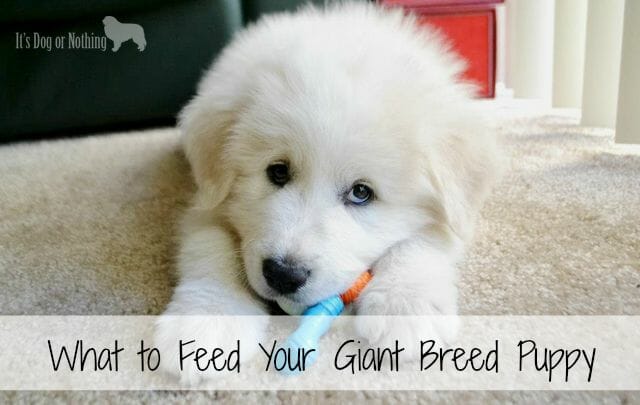
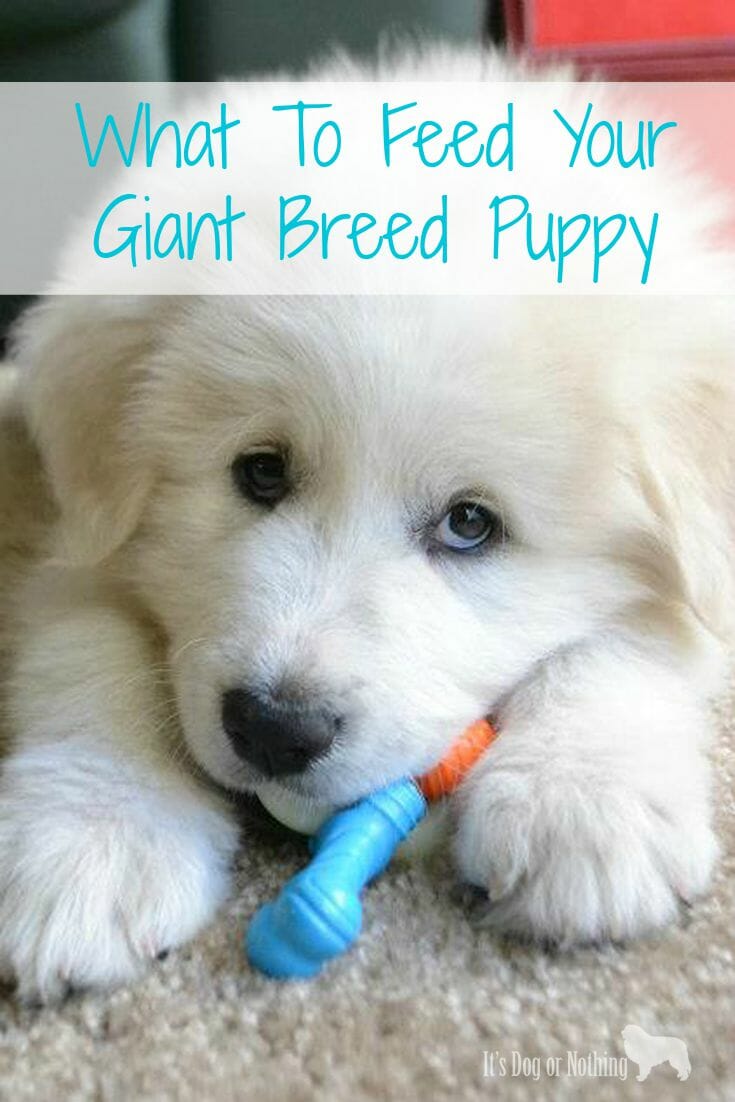
What To Feed Your Giant Breed Puppy

July 27, 2015 26 Comments

Mauja at 8 weeks :)
Mauja at 8 weeks 🙂

In our society, bigger is better (just look at iPhones these days!). Unfortunately, the “bigger is better mentality” has transferred into dogs, especially giant breeds. Many people want their giant breed as big as possible, as soon as possible. I often see people exclaim proudly, “My 5 month old is already 80 pounds!” However, promoting rapid growth for a giant breed puppy is one of the most detrimental things a new dog parent can do.

Growth in giant breeds is a topic that is starting to be studied more thoroughly. The nutrition we give to a Maltese puppy surely shouldn’t be given to a Great Pyrenees puppy, but it happens all of the time. Most of the time it occurs from a simple lack of knowledge and inaccurate data from dog food companies. But just what should new giant breed puppy parents look for in a dog food?

For many years, low protein content was the recommended food strategy for giant breeds. However, that was debunked in 1991 by Nap et al. that found dry matter protein from 23% to 31% did not have an adverse effect on skeletal growth. We know now that there are two important factors when choosing a food for your giant breed puppy: overall caloric intake and calcium level. Both aspects play an important role in your puppy’s growth rate which should be kept slow to avoid developmental orthopedic diseases, such as osteochondrosis.

Osteochondrosis in dogs is noted as a disruption in endochondrial ossification that results in a focal lesion. It occurs in the physis or epiphysis of growth cartilage. When it occurs in physeal cartilage, it may cause growth abnormalities such as angular limb deformities in long bones. Osteochondrosis of the articular epiphyseal cartilage commonly occurs in the shoulder, stifle, hock and elbow. – Ed Kane, PhD

The Problem With Excess Fat & Calcium

Giant breed puppies should be kept lean as a primary risk factor for developmental orthopedic diseases (DOD) is being overweight; making calorie control essential. Most veterinary nutritionists recommend diets of giant breed puppies consist of at least 30% protein and around 9% fat. Since most commercial puppy and adult foods often contain 10 – 25% fat, it is important to thoroughly read the nutrition facts prior to choosing your puppy’s food. Most raw diets contain 20 – 40% fat which is also too high for giant breed puppies. Giant breed puppies fed a high fat, low carbohydrate diet have been shown to have a high body fat level and increased risk for DOD.

The second risk factor for DOD is a diet high in calcium and excess minerals. A high level of calcium means too high of absorption into the bone structure and furthermore, skeletal abnormalities. These include hypertrophic osteodystrophy, craniomandibular osteopathy, and lesions in the skeleton and joints.The diet of a giant breed puppy should contain approximately 1.5% (or 3 grams/1000kcal) calcium content and 0.8 – 1.0% phosphorus (make sure you include treats in that calculation).

Ensuring Optimal Growth

After finding a giant breed puppy appropriate food, the next step is ensuring an ideal body weight. First, don’t free feed. You want to ensure your puppy is getting the necessary food and not any more. Second, ignore the feeding charts on the back of the bag (especially if you have a Great Pyrenees – their metabolism is very slow). The charts are usually grossly overestimated. Instead, go by look and feel of your puppy and try to keep him/her between a 4/9 and 5/9 for Body Composition Score (click here for a detailed BCS chart). Personally, I like to keep my giant breed puppies closer to a 4/9 to keep less weight on their joints.

To Sum It Up
  • At least 30% protein
  • Approximately 9% fat
  • 1.5% calcium
  • 0.8 – 1.0% phosphorus
  • Don’t free feed
  • Keep your puppy at a 4/9 or 5/9 body composition

Feeding a giant breed puppy may be a little difficult, but don’t let it overwhelm you. You are setting the foundation for your puppy to have a long, healthy life. While we don’t want your puppy to grow too fast, enjoy the little days because they won’t last long!

Determining what to feed your giant breed puppy can be challenging. Here is what you need to know.

References

Hazewinkel H. “Nutritional Management of Orthopedic Diseases”. Applied Veterinary Clinical Nutrition, Fascetti AJ and Delaney SJ, Eds. John Wiley and Sons, Oxford, UK, 2012.

Nap RC, Hazewinkel H, Voorhout G, van den Brom WE, Goedegebuure SA, van ‘t Klooster AT. “Growth and skeletal development in great Dane pups fed different levels of protein intake”. J Nutr. November 1991; 121(11 Suppl): S107-13.

http://ivcjournal.com/feeding-large-breed-puppies/

http://healthypets.mercola.com/sites/healthypets/archive/2012/04/09/slow-growth-diets-for-giant-breed-puppy.aspx

Filed Under: Healthy, Happy Dog, What's New Tagged With: food, giant breed, great pyrenees, nutrition, puppy

My Dogs are Still Dogs

June 22, 2015 18 Comments

They may be a bit giant,

and they’re definitely extra furry.

Their slobber might even coat your walls.

They’ll probably need their own chair or two,

and their chins might rest on the table.

Their “shake” might tumble a toddler,

and a lean could knock you off your feet.

Their bark might intimidate crowds,

and a playful bow could as well.

They’re not the best at tricks

or following your every command.

Their size might cause a reaction

from dogs much smaller or unsure.

But don’t forget the reality remains

My dogs are still dogs.

While most of us are familiar with breed discrimination, we don’t always consider size discrimination. Many people are fairly accepting (and even in love) with Mauja and Atka’s size, but some people are not as receptive. While I truly believe it’s rarely meant to be hurtful, the insinuation that my dogs don’t belong somewhere (that they are allowed) because of their size is always upsetting.

Dr. Seuss once said –

A person’s a person, no matter how small.

Well, I believe –


A dog is a dog, no matter how large.

Filed Under: Pyr Paw Around, Uncategorized, What's New Tagged With: dogs, giant breed, great pyrenees

Positive Training for Giant Breeds

February 3, 2015 35 Comments

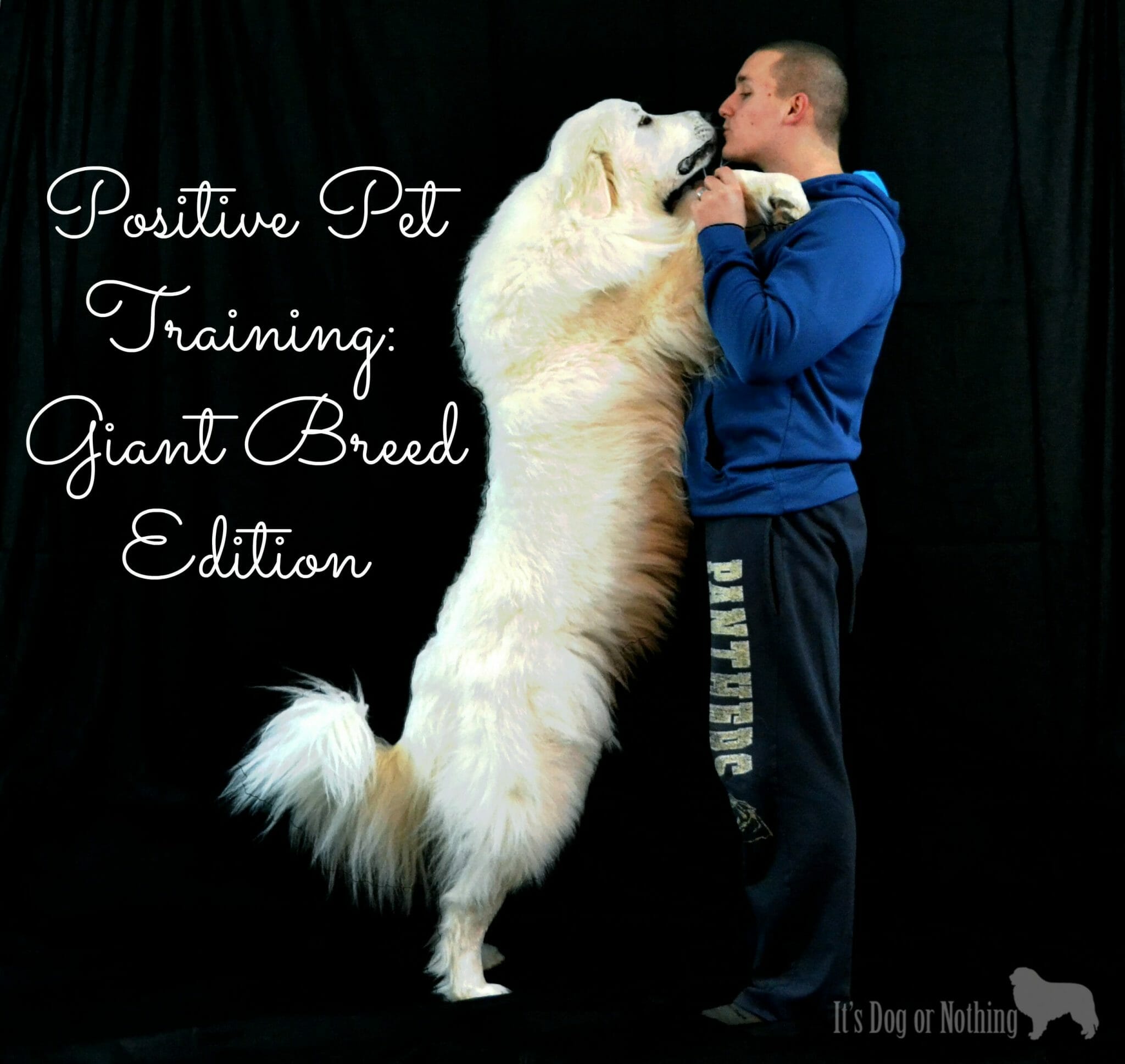
Positive Pet Training: Giant Breed EditionHaving a giant breed leads to many unique challenges as a dog owner. Having a giant breed puppy is even more challenging. Did you know that giant breeds typically don’t mature until at least 3 years of age? There’s a saying that’s associated with Bernese Mountain Dogs, but many other giant breeds follow it as well.

Three years a young dog, three years a good dog, three years an old dog.

Mauja and Atka are still in the ‘young dog’ phase at two and one years of age, respectively. Looking at them, you wouldn’t assume they are still puppies as they each have triple digit weights. However they still have ‘puppy brain’, which small to medium sized dogs outgrow around the one year point.

Unfortunately, many people believe that because of a giant breed’s size, force is a necessary training component. I recently read on a positive dog training group that the trainer “had to use force on a 4 month old St. Bernard puppy because of his size”. Sigh. Have I told you about the time I was kicked out of a training class for not using a prong collar or choke chain on a 5 month old Atka? That’s a story for another day.

Most giant breeds are extremely sensitive dogs and this is absolutely true for Great Pyrenees. Atka has been with us since 8 weeks of age and had a wonderful start to life, but any quick movement or gesture toward his collar makes him cower. He’s just a very sensitive boy. Can you imagine how he would be if I had used a prong collar on him as a puppy?

Force-based training is never necessity and a dog’s size is certainly no exception.

Effective training is a partnership between you and your dog. Love, compassion, and a mutual understanding will go a long way.

We’re joining the Positive Pet Training Blog Hop hosted by Cascadian Nomads, Rubicon Days, and Tenacious Little Terrier.

Filed Under: Pyr Paw Around, What's New Tagged With: blog hop, dogs, giant breed, great pyrenees, positive training

Eventually

August 1, 2014 30 Comments

With Nick being in the Air Force, there are a lot of unknowns in our life. Will we stay in one location for a year? For two years? Will we go overseas on our next assignment? Where will life take us? Will we be able to settle down? Will we be able to get more pets?

You just never know.

I’m learning to be very flexible. [Read more…] about Eventually

Filed Under: Fluffy Life, Pyr Paw Around Tagged With: giant breed, great pyrenees, rescue, service dog, therapy dog, training

  • « Go to Previous Page
  • Page 1
  • Page 2
  • Page 3
  • Page 4
  • Go to Next Page »

Primary Sidebar

Want to find something?

Raise That Pyr Paw

Raise That Pyr Paw

Welcome to It's Dog or Nothing, the go-to resource for all things Pyrenees.

  • Email
  • Facebook
  • Instagram
  • Pinterest
  • YouTube

Subscribe

Join our email list to never miss a post and gain access to exclusive deals!

Footer

Features

  • Blog
  • Amazon Shop
  • Pyr Apparel & Gifts

Join Me On

  • Email
  • Facebook
  • Instagram
  • Pinterest

Main

  • Home
  • About
  • Contact

Copyright © 2024 · Studio Mommy Themes · Custom Scene Images

Copyright © 2024 · Adore Me on Genesis Framework · WordPress · Log in · Privacy Policy

Follow on Instagram