5 Tips for Healthy Joints in Giant Breed Puppies with NuVet
Caring for a Great Pyrenees, or any other giant breed, can be tough if you’re not adequately prepared. These gentle giants have special needs to ensure their bones grow properly and they have healthy joints. Here are my 5 tips for healthy joints in giant breed puppies.
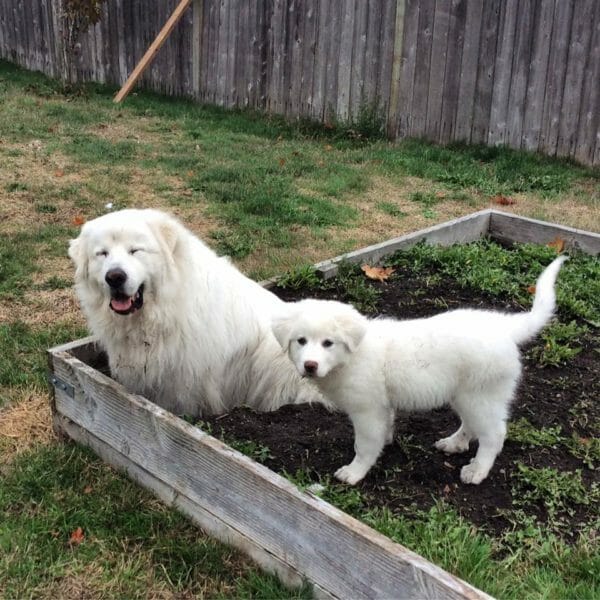
Our little Great Pyrenees puppy is 5 months! I can’t believe it. Time is flying – they grow far too fast. I did delete a few questions that I’ve been answering every month (like potty training questions) because they are no longer relevant.
I wonder if I’ll be able to pick her up next month… 😉
In honor of National Train Your Dog month, I wanted to address training a Great Pyrenees. Training a Great Pyrenees isn’t like training most dogs—they aren’t necessarily “eager to please.” While a Golden Retriever may do what you say because you said so, a pyr won’t be so likely.
I absolutely love training Great Pyrenees. They push me to my limits and challenge me in ways I never knew possible. Some days, they’re lucky their fluffy butts are so darn cute 😉 I’ve learned a few things over the years, so here are my top ten tips for training a Great Pyrenees.
1. Be patient
I cannot express how important patience is when training a Great Pyrenees. Pyrs do what they want on their own time. Don’t be surprised if your pyr takes ten or fifteen seconds to follow the command you asked for.
While it’s tempting, do not repeat your command over and over (i.e. “Sit, sit, SIT, SIT, SIT!!”). Ask your dog to sit and wait. If after several seconds your dog doesn’t listen or becomes distracted by something else, refocus and ask for the sit again. They will test you, so patience is a must.
A continuation of “be patient” is to be confident. A Great Pyrenees will challenge you. They are independent dogs that were bred to do their job without humans. That instinct doesn’t disappear in pet pyrs.
Confidence is not harsh. It’s sticking by what you asked your dog and requiring follow through. This leads me to…
3. Keep it positive
The Great Pyrenees is an extremely sensitive breed, despite their large size and sometimes intimidating demeanor. Hitting, screaming, alpha rolling, or other similar behavior will only harm your relationship with your pyr. If your pyr can’t trust you, he certainly won’t want to work with you.
4. Focus on bonding
I have noticed that the most obedient pyrs are the ones who have the greatest bonds with their people. Bonding doesn’t mean the dog is always by your side — rather you can feel the relationship you have with your dog.
Take your dog on walks, trips to the store — just spend time together. Always let your pup know when you’re happy. Praise is an amazing motivator when training a Great Pyrenees.
5. Keep a sense of humor
You’re going to lose your mind. It’s a part of having a Great Pyrenees, especially an adolescent. When you’ve been trying to get your pyr to sit for five minutes or get him inside all evening, you’re going to go a bit insane. Keep a sense of humor or no one will survive 😉
6. Take it slow
Pyrs are exceptionally smart, but they get bored easily. I never work with the big floofs for more than 10 minutes and only 5 minutes for baby floof. However, I do this several times per day. Add little down-stay sessions while you’re cooking dinner or brushing your teeth. Get creative and have fun with it!
7. Practice everywhere
Your pyr can have a rock solid down-stay in your home, but that will rarely translate into other situations. Get out and about to work with different stimulants and distractions. I love walking through pet-friendly stores to work on basic commands and overall socialization.
8. Use the right tools
Great Pyrenees are big, strong dogs. Adolescent pyrs will often drag you down the street. Gentle Leaders and no-pull harnesses are great positive tools for working on loose leash walking. Remember, these are tools, not solutions. It’s imperative to continue training and use these tools to keep you on your feet as they learn.
When they are puppies, you’ll think you have it all figured out. They’re listening immaculately, picking up on every skill, and just wonderful dogs. Then adolescence hits and your pyr suddenly forgets everything. He’s shredding things in the house again and looks at you like you have three heads when you ask for a simple down. This is normal and also why so many pyrs get surrendered at this age.
It’s all well and good when your 30-pound puppy is prancing around like a maniac. It’s a completely different story when your 100-pound puppy is doing the same thing. Plan for this to occur and never stop training.
10. Understand the breed
This is, by far, the most important thing when training your Great Pyrenees. If you understand the breed and how their minds work, you’ll have greater success. Here are a few articles if you’re looking for more information.
Since we’ve just started 2018, I wanted to take a look back at It’s Dog or Nothing’s Instagram photos over the past year. I went through and picked out my favorite 10 photos of Mauja, Atka, and Kiska and compiled them into this post (in no particular order). Pictures of Great Pyrenees are always fun, so enjoy the look back 🙂
New Year’s resolutions. Do you make them? Each year, I try and set goals for myself because I feel like they’re easier to stick to than resolutions. However, I always like to ask the fluffies for their Great Pyrenees New Year’s resolutions.
I sat down with each floof and here is what they told me:
Mauja
I will beg less – especially when it comes to popcorn and cheese. Those are delicious.
I will decide whether I truly want inside or outside and stay in that location for at least 5 minutes, rather than the typical 5 seconds.