• Blog
  • Amazon Shop
  • Pyr Apparel & Gifts
  • Nav Social Menu

    • Email
    • Facebook
    • Instagram
    • LinkedIn
    • Pinterest

It's Dog or Nothing

All Things Great Pyrenees

  • Blogwhat’s happening
  • Aboutwho we are
  • Breed Infoall things pyrenees
  • Mediapartner with the pyrs
    • Awards & Recognition
  • Contactlet’s chat
    • Updates & Exclusive Deals
    • Disclosure
  • Skip to secondary menu
  • Skip to main content
  • Skip to primary sidebar
  • Skip to footer

Archives for January 2016

Meet the Giants: Leonberger

January 25, 2016 15 Comments

This week on Meet the Giants - the Leonberger! Head over to the blog to read all about this gorgeous gentle giant!

Guys, I have just been itching for this Meet the Giants post! While I will always have Great Pyrenees, Nick and I have been really interested in Leonbergers for awhile.

They are beautiful, beautiful dogs with such great personalities. I’m sure we will have one sometime down the road! To avoid me gabbing on and on, I’ll turn it over to Susie Jump to talk about this absolutely striking breed.

All information and photos are credited to Susie Jump.

This week on Meet the Giants - the Leonberger! Head over to the blog to read all about this gorgeous gentle giant!

If you currently have a Leonberger, please list their names, ages, and gender.
FozzieBear 7.5yr entire male, MojoLion 6yr neutered male, FleaBagMonkeyFace 2yr entire male.

Are there any other names/nicknames for the Leonberger?
If yes, list here. Lean-on-berger (like most giants they make good use of you if you stay still too long!), Wookies (they talk like Wookies), Peruvian Teddy Bear Dog (one I made up, which I use when I get sick of saying Leonberger!  )

What are three words you would use to describe the Leonberger?
Agile, intelligent, majestic

What is the Leonberger’s average size?
Height at withers: Dogs 72-80cms (28¼-31½ ins) ranging between 120-180lb; Bitches 65-75cms (25½ -29½ ins) usually between 90 – 145lbs.

What are the acceptable colors of the Leonberger?
Lion gold, red, reddish brown, sandy (fawn or cream) and all combinations in between, always with a black mask. Black hair tips are permitted but black must not dominate basic colour.

This week on Meet the Giants - the Leonberger! Head over to the blog to read all about this gorgeous gentle giant!

What is the average lifespan?
8-10, although the oldest recorded Leonberger was 17!

What was the Leonberger bred to do?
The Leonberger was bred to represent the lion on the town crest of Leonberg

How much exercise does the Leonberger need?
They are the most active, agile and versatile of the giants! Mine regularly walk 6-8 miles a day. Although exercise is restricted for growing puppies, and any activity must be built up slowly.

What are some common health problems?
DCM, LPN, Hip/elbow dysplasia, cancer, cataracts, Glaucoma

How much grooming does the Leonberger require?
Extensive! They have a thick double coat, shed throughout the year, but will completely drop their coat at least once a year.

What do you wish people knew about the Leonberger before bringing one home?
They need early training and socialization! Too many are rehomed when they hit adolescence as they’ve suddenly become 10 stone loons due to lack of training!

Why do you love the Leonberger?
Because they’re so versatile, if you build a good relationship they will do anything you ask of them. My boys show, take part in water rescue and draught work, they’re therapy dogs and blood donors, they’ve competed at agility, flyball, and obedience, they’ve tried afghan racing and rig-racing, rally, tracking, dancing to music……………the list goes on!

This week on Meet the Giants - the Leonberger! Head over to the blog to read all about this gorgeous gentle giant!

Anything else you want to say?
They’re not for everyone. They love water, they love mud, they think they’re a lap-dog, they can destroy a 3-piece suite in seconds if bored, they shed hair like there’s no tomorrow, insurance is expensive, there are health problems, they are not suited to kennel life and need to be part of the family.

They like to bop you with a massive paw and butt you with a great big nose, habits that are cute as a puppy wear very thin as a 10 stone dog. They need to be kept occupied.

They love to work and walks take forever because everyone stops you! BUT if you click, you will find yourself with the most loyal, sensitive, loving, intelligent best friend in the world, and I guarantee you won’t stop at one!

Pin It!

This week on Meet the Giants - the Leonberger! Head over to the blog to read all about this gorgeous gentle giant!

Filed Under: Meet the Giants, What's New Tagged With: breed information, giant breed, meet the giants

Not All Dogs Want to be Inside

January 22, 2016 26 Comments

Warning: This is a rant post. I’m sure I’ll get some comments that strongly disagree, but I digress. If you don’t like rants, click away. I’ll see you on another day 🙂

Recently, a story came out about a Great Pyrenees mix that froze to death in the owner’s backyard. I can’t tell you how many posts I’ve seen stating, “See, double coated breeds shouldn’t be left out either!”

Great Pyrenees in the snow
Atka enjoying a massive snow pile 🙂

Now, I’m not advising to leave your dog outside just because he has a double coat. This story is beyond horrific and I’m heartbroken to see this happen to a dog. I’m saying to look at this story as more than just the dog froze to death.

Look at the picture of the dog. Does he look like he is well-taken care of? Does he look like he had a person that loved him unconditionally?

No. The “owner” has already been charged with animal cruelty twice.

While the article states he’s a Great Pyrenees mix, there’s no way to tell the dog’s actual coat type – especially with all those mats. In order for a double-coated breed’s coat to function effectively, it should be taken care of at mat-free. The insulating undercoat does just that – insulates the dog from the elements. How can it do that if it’s a matted mess?

It can’t.

Great Pyrenees were bred to do a job: guard livestock. The pyr would not be a very good livestock guardian if he came into the house when it got cold. That’s why they have a very thick undercoat.

Once again, I’m not suggesting that a pyr should be left out just because of the double coat. Responsible owners of LGDs ALWAYS have shelter available for their dog. It may be a warm barn outside, but it is a place for the dog to retreat and escape the elements.

For the most part, Great Pyrenees LOVE the cold. Mauja and Atka absolutely, positively will not come inside, regardless of the temperature. We’ve seen temperatures in the negatives with an even colder windchill and I still have to go outside and physically bring them in. They have zero interest in coming into the house. When they are inside, they are pawing at the door asking to go back out.

Many dogs do not have a thick undercoat and should not be left out in these frigid temperatures at all. Their bodies were not meant to handle the weather.

Many double-coated dogs are not “left outside”. After 15 minutes of the owner trying to get the dog’s fluffy butt inside, the owner finally gave up and let the dog do what he wanted. He chose to be outside.

Responsible owners ensure their dog has proper shelter from the elements. Crap owners leave their dog outside without shelter and completely unprotected. Responsible owners allow their dogs to go out if they want but monitor them to ensure safety. Crap owners force their dog outside when he obviously wants to be inside.

Situations like this are horrible and my heart hurts every time I hear about them. However, please stop condemning people that allow their double-coated breed to choose where he wants to be. If the dog is happy and monitored, that’s all that should matter.

Filed Under: Fluffy Life, What's New

Meet the Giants: Akbash

January 18, 2016 12 Comments

Today on Meet the Giants, the Akbash! Head over to read all about this amazing livestock guardian dog.

Today, we have another big, white, livestock guardian dog to talk about – the Akbash! Many thanks to Emily Musgrove for the information and Amanda Kaiser for the pictures 🙂

Today on Meet the Giants, the Akbash! Head over to read all about this amazing livestock guardian dog.

If you currently have an Akbash, please list the name, age, and gender.
I have fostered 14 Akbash mixes and 1 purebred mom. Ages ranging from 2 days old to 2 years old.

Are there any names/nicknames for the Akbash?
I only know them as Akbash, many mistake them for pyrs, or lab/pyr/golden mixes. They only come in white and are descents of the Anatolian Shepherd which comes from the Turkish Kangal. Akbash are basically white Anatolian’s but are now considered their own breed like the white GSD.

Today on Meet the Giants, the Akbash! Head over to read all about this amazing livestock guardian dog.

What are three words you would use to describe the Akbash?
Aloof, watchful, and loyal once they trust you.

What is the Akbash’s average size?
Breed size is 90-150lbs

What is the average lifespan?
10-12 years

What are common health problems of the Akbash?
Joint issues

Today on Meet the Giants, the Akbash! Head over to read all about this amazing livestock guardian dog.

How much grooming does the Akbash require?
Grooming, lots of brushing, lots of shedding. Tend to have double dew claws watch for rear dews too.

What was the Akbash originally bred to do?
Originally bred for guarding livestock mostly sheep and goats. They have less coat than a pyr so they do better in warmer climates.

Today on Meet the Giants, the Akbash! Head over to read all about this amazing livestock guardian dog.

What do you wish people knew about the Akbash?
This breed is aloof unless they trust you. If they choose to work you must still feed and take care of them or they will get up and leave. They can be difficult to motivate so they are not the dog for dog sports. They tend to be very quiet unlike the pyr and they also tend not to have prey drive problems. Mine have always loved cats.

Pin It!

Today on Meet the Giants, the Akbash! Head over to read all about this amazing livestock guardian dog.

Filed Under: Meet the Giants, What's New Tagged With: breed information, livestock guardian dog, meet the giants

Will My Great Pyrenees Bark All the Time?

January 14, 2016 57 Comments

Does your Great Pyrenees bark? If so, you are not alone. There are several reasons that the Great Pyrenees is surrendered to rescue, but the most common reasons include size, their tendency to roam, and to top off the list – Great Pyrenees bark. A lot.

There are many reasons why Great Pyrenees are surrendered to rescue, but one very common reason is because Great Pyrenees bark more than most dogs.

Whenever I talk with potential adopters about pyrs we always discuss what they should expect in regard to barking. They usually respond with, “Oh, my (insert breed here) barks all the time. I’m used to it.” I let out a chuckle and think, “we’ll see how you feel later”. I often joke that anyone interested in a Great Pyrenees should take Mauja for 24 hours and then decide how they feel about their current dog’s barking.

Great Pyrenees don’t typically bark much as a puppy, so a puppy’s bark is not indicative of how the dog will act once mature. Usually around 6-8 months, your Great Pyrenees will ‘find his voice’ as he matures into the guard dog he was meant to be. Mauja’s always been a barky butt (as we lovingly call her), but Atka didn’t make a peep until almost 9 months old.

Mauja and Atka bark at people, dogs, plastic bags, screeching cars, birds, someone shoveling, kids playing, yelling on TV, weird noises, objects that aren’t where they are ‘supposed to be’, and us when they’re feeling particularly sassy. Great Pyrenees bark at anything they feel could possibly be a threat. Furthermore, they don’t stop barking shortly after the sound occurs or when the person is beyond the yard. Great Pyrenees bark and bark until they are absolutely, positively sure that their message was heard and understood.

You cannot train a Great Pyrenees not to bark.

Let me say that again.

You cannot train a Great Pyrenees not to bark.

Yes, you can absolutely manage the barking, reduce its frequency and intensity, and remain on the good side of your neighbors, but attempting to eliminate pyr barking is going against their natural instincts. Asking a pyr not to bark is like asking a bird not to fly or a fish not to swim. I’m a firm believer in working with your dog’s natural instincts, not against them.

Great Pyrenees bark during the day and night. There are several tactics to help reduce the amount of barking and find a middle ground between your desires and your pyr’s instincts.

There are many reasons why Great Pyrenees are surrendered to rescue, but one very common reason is because Great Pyrenees bark more than most dogs.

Great Pyrenees Day Barking

The Great Pyrenees is a livestock guardian dog who was born with the natural instinct to guard his flock. The flock need not be livestock; it can very well be your family. Pyrs are not attack dogs and generally will not become aggressive with predators unless the situation becomes dire. They prefer to intimidate their enemy through their giant size and booming bark. Attempting to prevent your pyr from guarding will just lead to a confused, unhappy, and unstable dog.

A lot of the time, Great Pyrenees bark at things you can’t see or hear. Rest assured, they are indeed barking at something. It might be the sketchy-looking leaf that just blew by your backyard or a person coughing 3 miles away, but they are barking at something!

Dealing with Great Pyrenees barking during the day is a bit easier because you will generally have more understanding neighbors when the sun is shining. The technique that has worked time and time again is to thank Mauja and Atka for barking (read more about that technique here). Praising your dog for doing his/her job will go a long way in minimizing the amount of barking. However, sometimes your Great Pyrenees will get so worked up about something you can’t hear or see and nothing you say or do will quiet him down. Mauja and Atka will ignore their highest value treats when they are in serious guard dog mode. Simply bring your pyr inside (you’ll definitely have to go outside and get him!) until he calms down so your neighbors don’t hate you.

There are many reasons why Great Pyrenees are surrendered to rescue, but one very common reason is because Great Pyrenees bark more than most dogs.

Ideas To Reduce Barking

Socialize, socialize, socialize. Allow your pyr to experience the world around him and learn about different sources of stimulation. Socialization will allow him to determine what is ‘normal’ in his world and what are the possible sources of threat. Regardless of whether your pyr is 10 weeks or 7 years, socialization should occur. Dogs are most receptive to socialization as a puppy, but that doesn’t mean it should be neglected at an older age. The Great Pyrenees is naturally aloof so socialization will help prevent your pyr from being suspicious of those around him.

Exercise. Great Pyrenees have relatively low activity needs, but their exercise should not be pushed aside. 30-60 minute brisk walks each day will help your pyr to learn even more about the world and hopefully limit boredom barking. Great Pyrenees were bred to do a job so they need to be given the opportunity to use that energy in a productive way. Without proper exercise, pyrs will bark incessantly and/or become destructive.

Mental stimulation/training. The Great Pyrenees is an incredibly smart, yet independent, breed of dog. It’s important not to confuse independent with dumb. Pyrs were bred to work on their own without human direction so they typically have little interest in obedience training. However, it’s important to exhaust their minds to help lessen their barking. It will take time, but find what works for your pyr and keep sessions short as they bore easily. Atka has his Advanced Canine Good Citizen certification – it can be done! Kongs and other interactive toys are also great for keeping your pyr’s brain busy.

Thank your Great Pyrenees. This is hands down, the best technique I’ve tried so far. Never yell at your pyr for barking; he is doing his job! I talk more in-depth on this technique to reduce Great Pyrenees barking here. When you thank your pyr, go outside or over to him and acknowledge his work. Let him know that you’re grateful for the alert but you’ll take it from here. Your Great Pyrenees knows he needs to protect you, but he also knows that you will protect him.

There are many reasons why Great Pyrenees are surrendered to rescue, but one very common reason is because Great Pyrenees bark more than most dogs.

Great Pyrenees Night Barking

The Great Pyrenees is nocturnal by nature so typically their barking will increase once the sun goes down. Nighttime is when most predators will be active, so the Great Pyrenees had to adapt to best protect its flock. I have found that the most successful way to keep pyrs quiet at night is to establish a consistent bedtime routine.

Our bedtime routines started with Mauja and Atka on day one to try and get them on the same schedule as us. Every night we would do the same thing: evening potty break, bedtime treat, snuggles and a bedtime song (yes, I’m serious), and then finally crate time (when we were still working on house-breaking). Once they were each housebroken, our last step was to close the bedroom door so they were in there with us overnight.

A proper bedtime routine has been a complete game-changer for so many people who are frustrated by their pyr’s nighttime barking. People even tell me that they thought the bedtime song was ridiculous until they tried it. Some pyr’s latch so tightly to their routines that they’ll cry if you try and finish without their usual song! Mauja and Atka’s nighttime routine no longer includes the song, but we still do the same thing every night to keep things consistent.

I would also recommend purchasing a fan or a white noise machine to filter out the sounds that your Great Pyrenees will inevitably hear. I also advise against keeping your window open if you are still struggling with nighttime barking. They have exceptional hearing so Great Pyrenees bark at things you can’t hear. You want to drown out as many noises as possible.

Unless you live in the country and are using your Great Pyrenees as a livestock guardian, it is not recommended to leave them outside overnight. Mauja and Atka would be so incredibly happy if we let them outside overnight, but we would have the police knocking at our door at 1 am due to noise complaints. Trust me. When it’s dark they do. not. shut. up. I never worry that anything will sneak up on us, though!

Conclusion

Great Pyrenees bark. There are some pyrs that are naturally quiet, but they are the rare exception to the rule. Don’t get a puppy and expect to be able to raise him not to bark; their instinct is incredibly strong. If you are hoping to share your life with a quieter Pyrenees, talk with rescue groups where the dogs are living in foster homes. This will give you a better idea of what to expect in the dog (but remember, you never truly know how a dog will act in a different home).

If you learn to appreciate the breed-specific traits of a Great Pyrenees, you will never be able to imagine your life without one <3

Pin It!
There are many reasons why Great Pyrenees are surrendered to rescue, but one very common reason is because Great Pyrenees bark more than most dogs.

Filed Under: Pyr Paw Around, What's New Tagged With: barking, breed traits, dogs, great pyrenees, great pyrenees barking, training

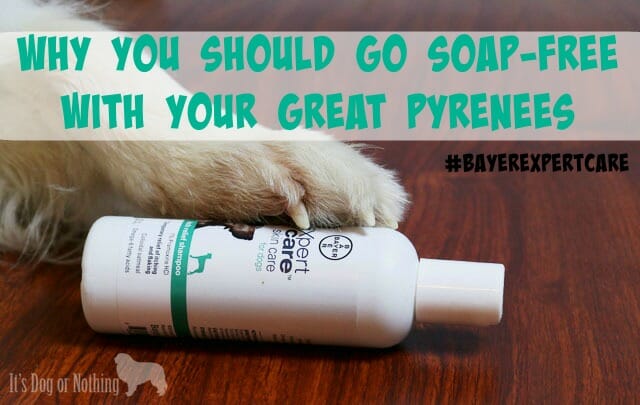
Why You Should Go Soap-Free with Your Pyrenees #BayerExpertCare

January 12, 2016 6 Comments

Why you should consider soap-free shampoo for your Great Pyrenees.I hear the same question over and over when people meet Mauja and Atka.

“How in the world do you keep them so white?”

I wish I could say that I have some magic formula that keeps white dogs perfectly white, but the Great Pyrenees has a self-cleaning coat. What does that mean (other than the fact that it makes my job a lot easier)?Bayer ExpertCareIf your Great Pyrenees enjoys a play session in the river, chances are she will look something like this:

Why you should consider dry shampoo for your Great Pyrenees.Or maybe your Great Pyrenees will find that one muddy spot in your backyard. He’d probably look like this:

Why you should consider soap-free shampoo for your Great Pyrenees.These situations make me so thankful for their self-cleaning coat. Once they dry, the mud/dirt will just flake off! If it doesn’t, you simply brush it out and voila – you have your white dog back!

Mauja and Atka get bathed a bit more frequently than necessary; the average Great Pyrenees only needs 3-4 baths per year. The fluffies get about 6 per year, but that is because they are house dogs. However, I know a few people who bathe their Great Pyrenees monthly. The most important thing is to watch their skin and coat health.

Frequent baths can strip the coat of its essential oils. These oils are responsible for keeping the coat self-cleaning, tangle free, relatively odor-free, and silky smooth. The problem really isn’t with the bath – it’s what is being used during the bath.

Your typical dog shampoo is soap based and that’s perfectly fine if you’re only bathing your Great Pyrenees every few months. It gets your pyr nice and clean and helps keep their coat and skin healthy. However, more frequent baths require a different approach.BayerExpertCareIf Mauja and Atka are getting a bath closer together than normal, I switch to a soap-free shampoo. Our current favorite is the Bayer® Expert Care™ Itch Relief Shampoo. I like this shampoo for a few reasons:

  1. Bayer Expert Care Itch Relief Shampoo is based with colloidal oatmeal. Colloidal oatmeal is simply oats that have been ground into a very fine powder that then moisturizes and protects the skin. This helps to ensure I’m not drying out their skin and coat.
  2. Expert Care Itch Relief Shampoo contains Pramoxine HCl. Great Pyrenees are known to have skin issues such as allergies and dry skin. Pramoxine HCl helps relieve rashes and dry, itchy skin. I always look for this ingredient coupled with colloidal oatmeal when trying to relieve irritated skin.
  3. Expert Care Itch Relief Shampoo is formulated with Omega-6s. I talked in a previous post about the importance of Omega-6s for maintaining and healthy, shiny coat. Pyrs benefit greatly from this addition to their grooming routine.
  4. Maximum effect is reached in just 3-5 minutes after initial application. We all hate seeing our furbabies uncomfortable. If Atka’s skin is acting up I can get him a quick bath or spray him with the Itch Relief Spray for quick relief.

Why you should consider soap-free shampoo for your Great Pyrenees.

The best part about the Bayer Expert Care Itch Relief shampoo is that it can be purchased at PetSmart. We are there quite frequently so it’s very simple to just grab a bottle during our normal shopping trip. The Expert Care line has several products to provide ultimate skin care for your dog (or cat) and we’ve been very pleased with the few we have tried so far.

Have you ever tried soap-free shampoo as a part of your dog’s grooming routine?

Pin It!

Why you should consider soap-free shampoo for your Great Pyrenees.

Filed Under: Reviews, What's New Tagged With: #bayerexpertcare, great pyrenees, grooming, itch relief, shampoo

Meet the Giants: Neapolitan Mastiff

January 11, 2016 Leave a Comment

This week on Meet the Giants, we're talking about the Neapolitan Mastiff! Read more for tons of fabulous breed information!

This week on Meet the Giants, we’re talking about the Neapolitan Mastiff! Emily Musgrove has been amazingly helpful with the past several posts and she’s here again today.

When we were looking to adopt Kaeto, we were stuck between him and a Neapolitan Mastiff puppy. He was an adorable pile of wrinkles and about 12 weeks old. Obviously, Kaeto came home with us, but we often wonder how that puppy is doing today!

All photos and information are property of Emily Musgrove.

If you currently have a Neapolitan Mastiff, please list their names, ages, and gender.
Cain, Tawny, Gwendolynn, Moogie, Fosters ages 8 months to 7 years.

This week on Meet the Giants, we're talking about the Neapolitan Mastiff! Read more for tons of fabulous breed information!

Are there any other names/nicknames for the Neapolitan Mastiff? If yes, list here.
Neo

What are three words you would use to describe the Neapolitan Mastiff?
Sensitive, Goofy, Dramatic

What is the average size of a Neapolitan Mastiff?
Most are between 100-150 males can be up to 200. Most of mine were 120.

What are the acceptable colors of the Neapolitan Mastiff?
Blue, black, mahogany, and brindle are all listed colors.

This week on Meet the Giants, we're talking about the Neapolitan Mastiff! Read more for tons of fabulous breed information!

What is the average lifespan?
10-12 years

What was the Neapolitan Mastiff bred to do?
Neapolitan Mastiffs are guard dogs, but as most mastiffs they will guard you and not your things.

How much exercise does the Neapolitan Mastiff need?
High for a mastiff but low for most breeds. 1-2 mile walks are plenty.

What are some common health problems?
Heart disease, joint problems, eye problems.

This week on Meet the Giants, we're talking about the Neapolitan Mastiff! Read more for tons of fabulous breed information!

How much grooming does the Neapolitan Mastiff require?
They do shed a lot of little short hairs but no hair cuts or anything extra.

What do you wish people knew about the Neapolitan Mastiff before bringing one home?
Research!!!!!! This is not a breed for 90% of the population. They are only loyal to the family and they do not like change or strangers. Please don’t pick a Neo because you want a blue dog. They are amazing but not the easiest breed to care for.

This week on Meet the Giants, we're talking about the Neapolitan Mastiff! Read more for tons of fabulous breed information!

Why do you love the Neapolitan Mastiff?
I love the spunk, the attitude,  and they are not for everyone. They love their family but not many others. I love that they are agiler than most mastiffs but still laid back.

They get their feelings hurt and do not respond well to punishment or force. They really need positive reinforcement based training. I said previously, “Tell a Boerboel to do something and they will give you a look. Make them do it and you will get hurt. Ask them to do it and reward them and they will jump over the moon for you.”

The same could be said of Neos.

Interested in adopting/learning more about the Neapolitan Mastiff? Head over to Big Dogs Huge Paws to see their list of adoptable Neos! Did you learn anything new about the Neapolitan Mastiff?

Pin It!

This week on Meet the Giants, we're talking about the Neapolitan Mastiff! Read more for tons of fabulous breed information!

Filed Under: Meet the Giants, What's New Tagged With: breed information, giant breed, meet the giants

National Train Your Dog Month

January 7, 2016 6 Comments

logo_tydm

First, I just wanted to thank everyone who has participated in the survey. I’ve been going through the responses and have been beyond overjoyed with the kind comments made by so many of you! Just gives me the warm and fuzzies 🙂 If you haven’t filled a survey out yet, you can do it here and be entered to win a $25 Amazon gift card! Over the next month or so, a few new series will begin on It’s Dog or Nothing. Stay tuned!

Now, on to the post!

January is National Train Your Dog month. As weird as this probably seems, I really enjoy training with Mauja and Atka. Even though their pyr independence prevents “perfect obedience”, I love the challenge. Their minds are fascinating and I enjoy working with their instincts (and laughing when their instincts take over).

My obedience training with Mauja is fairly limited due to her anxiety. If you’re not aware, Mauja struggles in new places. She’s completely fine outside, but she becomes immediately stressed when we go inside. Some places are worse than others, but there are very few places that she is truly comfortable. We’re not sure what triggered this anxiety as she went everywhere with us as a puppy for socialization. When she was about 7 months, something changed. We keep working with her, but I doubt she’ll ever be completely comfortable in new places. That’s okay – I’m a bit of a homebody, too 😉

Atka is a completely different story. He is the most chill, laid back dog ever. He’s such a “go with the flow” guy and makes himself at home wherever he goes. I admire that about him! Because he’s such a social butterfly, we can do a lot of work out in the community. This also makes him perfect for therapy work!

Sometime this year, we will complete Atka’s therapy dog test. There really aren’t any evaluators near us so we’ll have to plan a trip; hopefully by summertime! Atka will be pretty busy with therapy visits, but I want to find other activities to do with him. Two have come to mind: rally and agility.

We won’t be winning any awards for speed! 😉

I know what you’re thinking… “A pyr in rally? A pyr in agility? What?” You heard me right! Do I think we’ll be competitive? No. Do I think we’ll have fun? Yes! Nothing makes me happier than spending time out and about with Atka and I know he feels the same. We just need some more activities. Unfortunately, we don’t have any places nearby that offer rally, but hopefully, we’ll have options next time we move (whenever that may be).

We like to set up "obstacle courses" filled with toys, treats, and water (his biggest challenge!).
We like to set up “obstacle courses” filled with toys, treats, and water (his biggest challenge!).

Since January is National Train Your Dog month, I’m going to try and get Atka signed up for some sort of agility class to learn the basics. We recently learned that he can jump (more on that silly story later!) and he did very well in puppy agility.

For Mauja, we’re going to work on her novice title from Do More With Your Dog. I think she could pass right now, but I’d like to do a bit of sprucing up on her skills first!

Do you have any plans for National Train Your Dog month? Have you particiapted in rally or agility?

Positive Pet Training Blog Hop

This post is part of the Positive Pet Training Blog Hop, hosted by Cascadian Nomads,Tenacious Little Terrier and Rubicon Days. This month’s theme isNational Train Your Dog Month and the next hop begins on February 1st. The hop happens on the first Monday of every month, and is open for a full week – please join us in spreading the word about the rewards of positive training!


Filed Under: Fluffy Life, What's New Tagged With: agility, great pyrenees, training

Meet the Giants: Kangal

January 4, 2016 2 Comments

Today on Meet the Giants, the Kangal! Head over to learn more information about this stunning livestock guardian dog.

With the busy holiday season, it’s been a few weeks since I’ve done a Meet the Giants post! Time to get back in the swing of things and get posting again. Without further introduction, the Kangal!

(Images and information provided by Emily Musgrove)

If you have/had a Kangal, please list their name, age, and gender.
Indy, pure breed female, 7 mix puppies

Today on Meet the Giants, the Kangal! Head over to learn more information about this stunning livestock guardian dog.

Are there any other names/nicknames for the Kangal? If yes, list here.
No.

What are three words you would use to describe the Kangal?
Independent, Aloof, Watchful.

What is the Kangal’s average size?
Most are between 100-150 males can be up to 200. Most of mine were 120.

What are the acceptable colors of the Kangal?
Variation of blond with black mask. Can have a saddle.

Today on Meet the Giants, the Kangal! Head over to learn more information about this stunning livestock guardian dog.

What is the average lifespan?
10-12 years

What was the Kangal bred to do?
Guard livestock in Turkey

How much exercise does the Kangal need?
1-2 mile walks are plenty

What are some common health problems?
Heart disease, joint problems, eye problems.

How much grooming does the Kangal require?
They do shed a lot of short hairs but no hair cuts or anything extra.

Today on Meet the Giants, the Kangal! Head over to learn more information about this stunning livestock guardian dog.


What do you wish people knew about the Kangal before bringing one home?
Research!!!!!! Kangals are meant to work; they are a rare breed but not for everyone. They need a job and someone to help them decide between friend or foe.

They tend to bark and not like new people in their home. Indy would bark her head off but because she trusted me to keep the family safe, I could tell her to stand down and she would sit back and watch or decide she liked the person and play like a puppy.

Why do you love the Kangal?
They are a hoot. They tend to be very watchful with strangers but silly butts with their family. You can’t get anything past them. If they want to work they will, if not they won’t. They are very loyal and once they have a good relationship they will do everything for their family.

Today on Meet the Giants, the Kangal! Head over to learn more information about this stunning livestock guardian dog.

Anything else you’d like to say?
Kangals are one of the rarest breeds in the US. They are not allowed legally out of Turkey. Almost all of the ones found in the US trace back to a few dogs there were smuggled here in the 70’s.

Be careful when looking for one, many are inbreed or are mixes. Kangals are the original or motherland of the LGD’s. The Anatolian came from the Kangal, the Akbash indirectly too.

What a stunning, stunning breed! I had no idea that they aren’t legally allowed out of Turkey. Definitely something to be aware of if you are interested in the breed and living outside of Turkey. Thanks again to Emily!

Did you learn anything new about the Kangal?

Pin It!

Today on Meet the Giants, the Kangal! Head over to learn more information about this stunning livestock guardian dog.

Filed Under: Meet the Giants, What's New Tagged With: breed information, giant breed, meet the giants

Primary Sidebar

Want to find something?

Raise That Pyr Paw

Raise That Pyr Paw

Welcome to It's Dog or Nothing, the go-to resource for all things Pyrenees.

  • Email
  • Facebook
  • Instagram
  • Pinterest
  • YouTube

Subscribe

Join our email list to never miss a post and gain access to exclusive deals!

Footer

Features

  • Blog
  • Amazon Shop
  • Pyr Apparel & Gifts

Join Me On

  • Email
  • Facebook
  • Instagram
  • Pinterest

Main

  • Home
  • About
  • Contact

Copyright © 2024 · Studio Mommy Themes · Custom Scene Images

Copyright © 2024 · Adore Me on Genesis Framework · WordPress · Log in · Privacy Policy

Follow on Instagram